
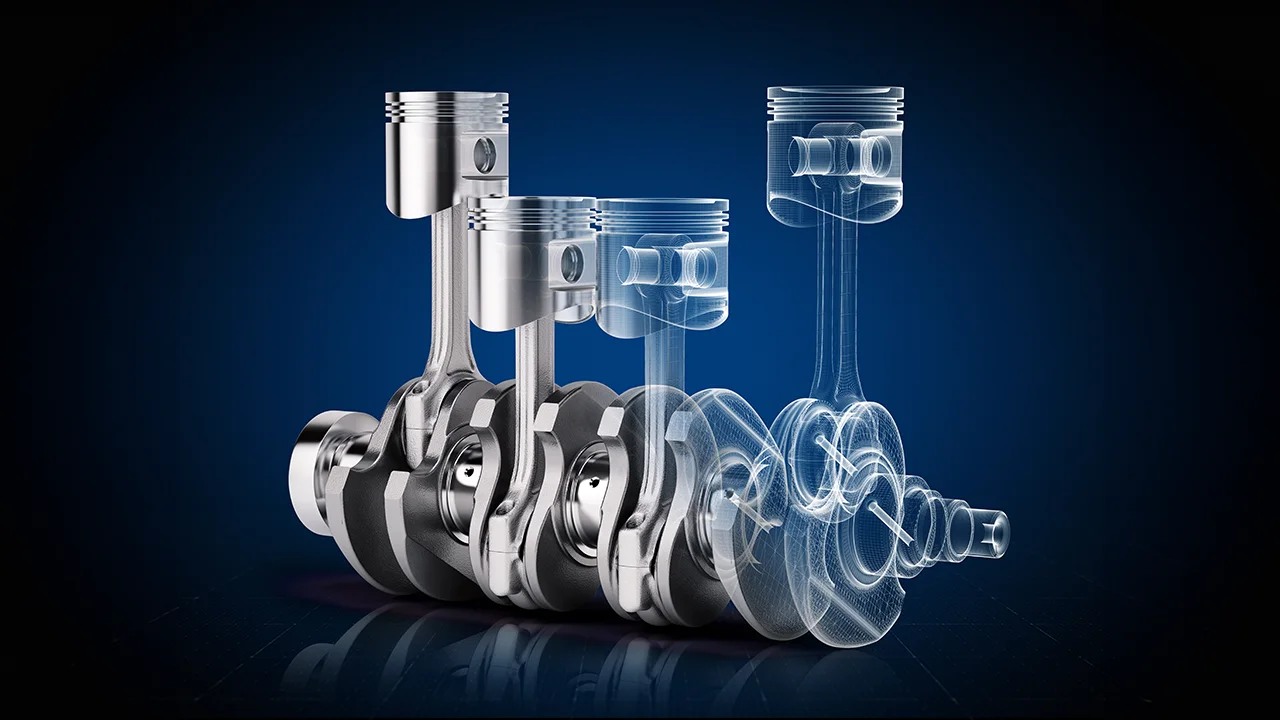
Reciprocating engines appeared in the late 19th century. For more than 130 years since then, the vertical movement of the piston has continued to play a central role in “generating power.” Car engines, compressors in household refrigerators, oxygen concentrators in medical settings, compressors in air conditioning units. ── Pistons are built into every site where power is handled.
And all of them had something in common that was “unavoidable.” Vibration, noise, and mechanical losses.
Why did ‘it have to be helped’
When the piston converts from reciprocating motion to rotational motion, the crank and connecting rod always intervene. This mechanism itself operates according to textbook standards. The problem is that the piston repeats the cycle of “accelerating from zero to speed and then decelerating back to zero” at top and bottom dead centers.
Inertia arises with every acceleration and deceleration. All of this goes out as vibration, noise, and heat (= machine loss). Adding balance weights to cancel them out, using flywheels to reduce uneven rotation, reducing transmission to the chassis with vibration-damping rubber—all engineers around the world have done so far have been approaches to “somehow suppress losses that go outside.”
There was an engineer who said, ‘We won’t even release it in the first place.’
About 20 years ago, I was obsessed with a certain question.
The mutual conversion between the reciprocating motion of pistons and rotational motion — could it really be achieved without mechanical losses in the first place?
The first thing I relied on was the inner cycloid curve. When a rotating circle with half its radius rolls inside a fixed circle, the trajectory drawn by any point on the circumference of the circumference becomes a straight line. It is a geometric fact known for over 200 years.
In other words, the movement of the center of the inner cycloid’s circumference is the “rotational motion itself,” and the movement of points on the circumference is the “reciprocating linear motion itself.” ── If a crank mechanism physically realizes both simultaneously, “reciprocating ⇄ rotation” should be possible without conversion loss.
The model was rebuilt three times.
The first model did spin, but it produced three times the friction expected. The second time, the adjustment of the center of gravity of each moving part was too loose, causing intense vibrations when spinning at high speed. The balance adjustment was redesigned in three stages: individual pistons→ second crankshaft→ and all moving parts.
On the third try, I finally achieved ‘uniform rotational speed.’ All moving parts continue to rotate at a constant speed relative to each rotational axis—with virtually zero vibration and mechanical losses. At this point, I finally filed a patent application.
With an air engine, the car really ran
Subsequently, through joint research with Waseda University, we commercialized this mechanism as a compressed air-driven air engine. A go-kart actually runs on a cylinder filled only with compressed air—after several prototypes, we actually arrived.
During this phase, additional patents were obtained, and international applications to the United States, Germany, and the United Kingdom were also proceeded in parallel.
However, the true sense of accomplishment for me was neither the patent number nor the award. “What was considered ‘unavoidable’ for over 100 years was actually unavoidable”—the very fact that this was proven by a go-kart is what supported 20 years of research.
What should this technology be used for?
The fully rotary balanced cylinder device is now entering the verification phase for its application field.
The application that comes to mind immediately is medical devices. Oxygen concentrators—by eliminating the vibration source itself, the noise from devices that run late into the night in hospital rooms can be fundamentally reduced. Dental compressors—vibrations from devices operating in front of patients can be reduced to less than one-quarter of the acceleration at the installation surface.
Beyond that, compressors for air conditioning and refrigeration units, various pumps, internal combustion engines, and turbopumps. ── The fields where piston systems are used are all potential applications.
Conclusion — “It Can’t Be Helped” Is Doubtful
Technological progress is not just cumulative. At some point, a solution that was considered “this is the standard” might have a better approach if taken with a different physical approach. The problem is that trying that alternative solution requires research spanning 5, 10, or 20 years.
We at Air Surf Co., Ltd. were established to ensure a “not-so-short research period.” We don’t have marketing budgets or flashy proposals—instead, we invest those management resources into prototypes, measuring equipment, and research time.
The ‘can’t be helped’ that has been left untouched for 100 years still lingers here and there. Where should we doubt next── We eagerly await the voices of those with on-site experience.
Author Profile
Chief Research and Development Officer at Air Surf Co., Ltd. Engaged for many years in research and development of power technology.